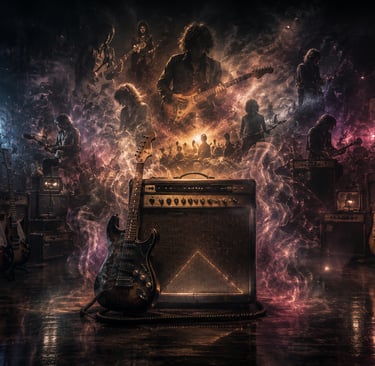
Brand Mythology
Why It’s OK to Believe in a Little Fantasy
5/30/20263 min read

There is a certain kind of guitar gear story that does not come from a spec sheet.
It does not come from the country of manufacture, the pickup resistance, the transformer brand, the cabinet wood, the circuit revision, or the resale graph. Those things matter, but they are not this.
It also does not come from signature models, exactly. Signature guitars and amps carry their own kind of lore. They come with artist association, imitation, aspiration, and sometimes a little hero worship wearing factory strings. That probably deserves its own article.
This is something else.
This is brand mythology.
The mystique around the logo.
The feeling that arrives before the first note.
The thing you cannot quite put your finger on, but somehow a room full of players can still recognize. Everybody remembers seeing one in the corner of a music store. Everybody has some version of, “I don’t know, there was just something about it.”
That something is powerful.
A lot of it started before we knew enough to question it.
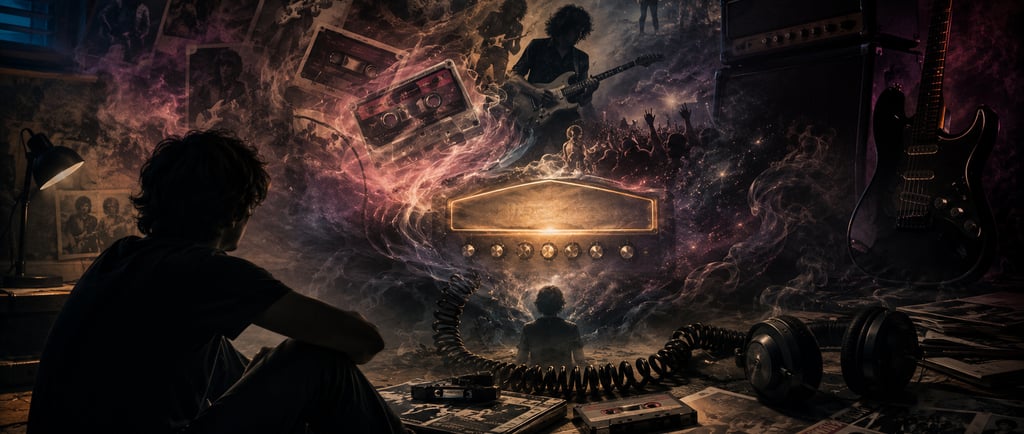
It came through cassette covers, headphone wires, guitar magazines, band photos, and music store walls. It came from music videos where unplugged guitars somehow sounded mythical, and from magazine ads where a guitar or amp sat surrounded by player names and band names we admired, even if we were too young, too distracted, or too uninterested to understand how endorsements actually worked.
We did not know the business arrangement.
We saw the image.
We saw the logo next to the sound in our head.
That was enough.
A Marshall stack did not just mean an amplifier. It meant volume, danger, arenas, denim, smoke, and probably someone’s older cousin who knew three Van Halen songs badly but played them with complete authority.
A Vox did not just mean British engineering. It meant chime, pageantry, British Invasion television lights, and a kind of Queen-sized stage mythology that reached us long before we understood artist deals.
A pink Charvel, a pointy Kramer, a black Les Paul Custom, a white Strat, a JCM800, a Rat pedal, a Tube Screamer — none of these things arrived in our imaginations as neutral equipment.
They arrived already surrounded by image and attitude, and when those two are mixed together, you get swagger.
That swagger matters.
Not because it is always accurate. Not because the stories are always true. Not because the marketing departments were noble public servants guiding us toward better gear.
It matters because it became part of why we cared.
There is an intangible part of guitar gear that lives somewhere between memory, image, sound, and wanting. It is the strange emotional charge attached to a logo, a shape, a color, a control panel, or a nameplate. It is why two pieces of gear can do similar jobs, but only one of them makes you stop scrolling.
Brand mythology is not the same as quality.
It is not the same as usefulness.
It is not the same as value.
But sometimes it becomes part of value.
Because the fantasy is not always bad. Sometimes the fantasy is exactly what keeps the guitar in your hands. Sometimes the amp in the corner looks cool enough that you plug in for ten minutes when you were about to do something else. Sometimes the logo does not make the sound better, but it makes the experience feel better.
And if you are playing more, that is not nothing.
But every good gear story eventually has to come out of the legend and sit in the room with the rest of your life.
A brand story can make a piece of gear more desirable. It cannot make it lighter. It cannot make it fit your room. It cannot make five watts behave like fifty. It cannot make a bad neck feel right, a noisy pedal quiet, or a stiff amp suddenly responsive.
The mythology can invite you in.
It cannot do the playing for you.
That is the balance.
There is nothing wrong with believing in a little fantasy. Electric guitar has always lived there. It is wood, wire, magnets, tubes, speakers, circuits, and then some ridiculous emotional charge that somehow makes all of it come together and feel larger than reality.
Brand mythology can be part of the decision. It just should not become the decision.
A piece of gear can have myth around it, and maybe some gear should never have that myth revealed. It can have history, memory, image, attitude, and that strange retail foreshadowing that made it feel important long before we ever touched one.
But after the legend settles a little, the same questions remain.
Do I want to play it?
Does it fit my actual life?
Can I afford the fantasy?
And when the logo stops glowing, is there still a good piece of gear sitting there?
That is the part worth finding out.