You’ve Earned the Wear. Now the Guitar Matches.
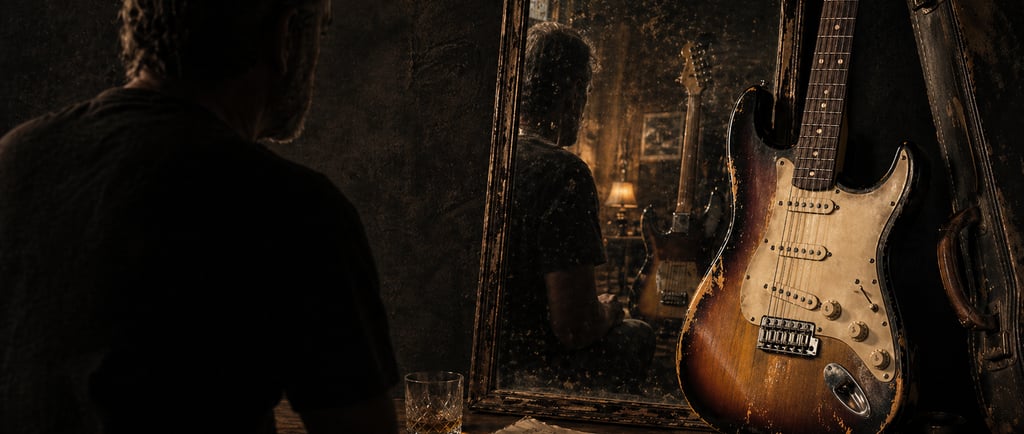
Relic guitars get accused of fake history, but for many adult players, the appeal is not fantasy. It is comfort, perspective, and the relief of an instrument that no longer needs to stay perfect.
4/27/20262 min read
There is a long-running complaint about relic guitars:
You didn’t earn those scars.
The buckle rash is fake.
The finish checking is fake.
The worn arm contour is fake.
The cigarette burn probably came from a guy in a factory with a checklist and a heat gun.
Fair enough.
But here is the part nobody wants to say out loud:
By the time a lot of players hit their late 40s, 50s, 60s, and beyond, they have already earned plenty of relic work themselves.
Surgeries.
Broken bones.
Missing hair.
Repaired teeth.
Bad backs.
Bad knees.
Health scares.
Divorce.
Money stress.
House problems.
Family loss.
Career damage.
One shoulder that clicks for no clear reason.
And at least one scar you do not remember getting, but are pretty sure involved doing something stupid with confidence.
So maybe the guitar did not spend thirty years in smoky bars, bad vans, pawn shops, basements, and questionable rehearsal rooms.
But the player did.
That changes the argument a little.
A relic guitar is often mocked as a shortcut to fake history. Sometimes that criticism is deserved. Some relic jobs look like the guitar was dragged behind a landscaping trailer and then apologized for by the marketing department.
But the better ones do something else.
They remove the fear.
A perfectly glossy guitar can feel like a museum object. You baby it. You wipe it down. You worry about the first scratch like it is a character flaw. It sits there under the lights looking expensive, fragile, and slightly disappointed in you.
A worn-in guitar feels different.
It already crossed the line.
You can pick it up without feeling like you are ruining it. You can play it after work. You can lean into it. You can set it down without needing a full emotional debrief. It feels less like an object to preserve and more like a tool that has already accepted its assignment.
That matters.
Especially for the adult hobbyist.
Most of us are not going to earn natural road wear the old-fashioned way anymore. We are not doing 220 shows a year. We are not loading into clubs through the kitchen. We are not sweating through three sets under beer signs while the drummer argues with the sound guy.
We are living in the world of Rational Soundcheck.
We are playing in real rooms, at practical volume, after dinner, before bed, with work in the morning, a few responsibilities still hanging over our heads, and maybe a spouse in the house. That is not failure. That is real life.
And real life changes your sense of time.
When you are younger, there is always plenty of time. Plenty of years. Plenty of gigs. Plenty of chances to slowly wear the finish off a guitar one honest scrape at a time.
Later on, that math starts to look different.
At a certain point, buying a relic guitar is not always about pretending you lived someone else’s road life. Sometimes it is just the honest acknowledgment that you may not have enough time left to wear out a guitar this well.
That is not sadness. That is clarity.
Maybe buying a relic guitar is not pretending.
Maybe it is admitting you have already lived enough of your own life to understand the appeal.
Maybe the guitar finally matches the player.
You have earned every relic and scar on you.
Now the guitar matches.
And if that makes you pick it up more often, play longer, worry less, and feel like the thing already belongs in your hands, then the argument gets very simple:
That is utility.
That is substitution.
That is rational.
The guitar does not need to prove where it has been.
Neither do you.
You made it.